Sean Major-Campbell | Rasta vibrations about apology and repair
Loading article...
-
 Photo - File
-
Photo - File
-
 Contributed
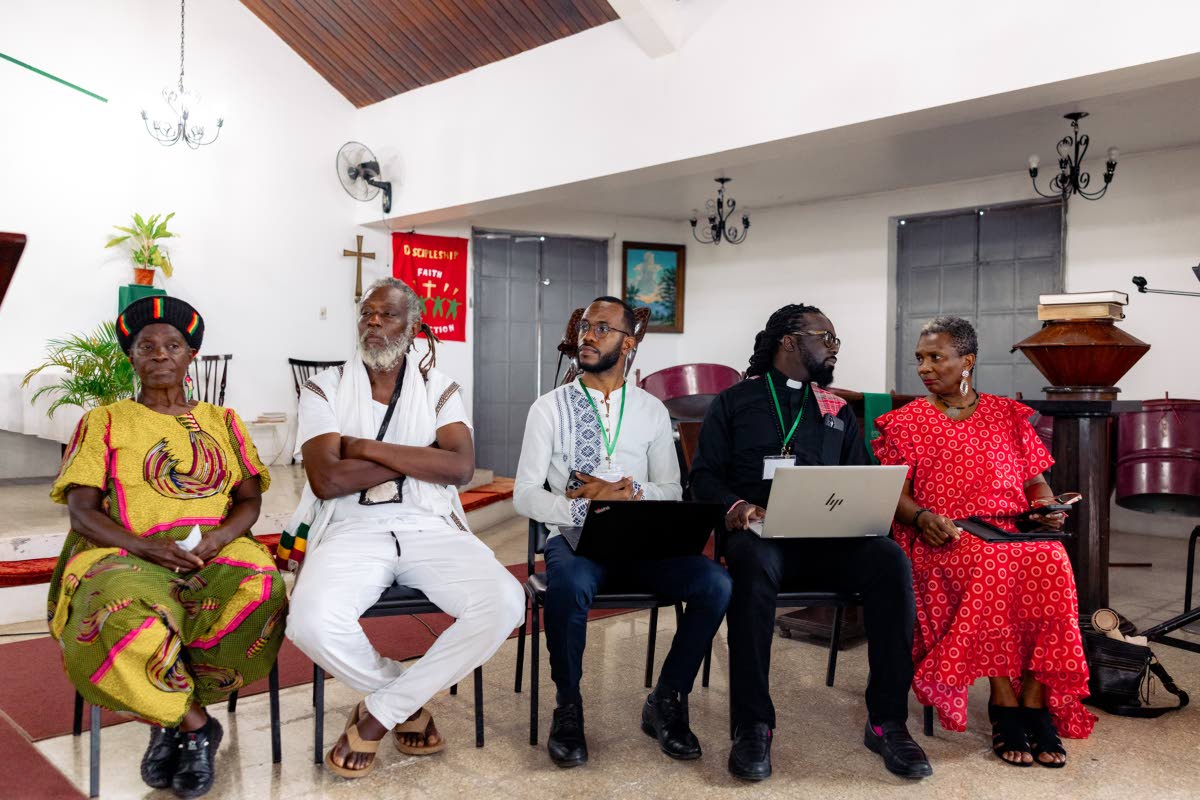
From left; Sister Nanny, First Man, Dr. Kirt Henry, Rev. Bertram Gayle and Rev. Marvia Lawes in the St. Augustine Church, in Coral Gardens. Photo - Contributed
This week we hear more from Yaad Repair reasonings where Anglican priest, Reverend Bertram Gayle introduced his presentation with a story from rural Jamaica. “In rural Westmoreland, where I am from, we occasionally tie chickens to prevent them from wandering off and causing havoc. Interestingly, when the string is eventually loosened, the chicken often remains in the same position, behaving as though it is still restrained. To get it moving, we sometimes pick it up, toss it into the air and exclaim, “Shi fowl!” It is then that it goes wherever it wishes, regaining its sense of agency.”
He noted, “I find this a useful metaphor for decolonisation in the Caribbean space: even when the formal structures of colonial domination have been dismantled, we often remain imprisoned by the various constraints they instilled in us. The string has been removed, but we have yet to realise that we are free to move on, to choose our own path. What we need, then, is a collective “Shi fowl!”
What is Father Bertram saying? Is the church to be seen as a fowl? Is Jamaica the fowl? Are you the fowl?
He contends that 1) “We have not sufficiently articulated or framed the various initiatives and efforts undertaken by our people as forms of reparation in their own right, beyond the conventional framing of reparatory demands directed at former colonial powers and other colonising entities.” And 2) “My second contention is that colonial Christianity aided and abetted many harms against our people, including epistemicide, and that liturgical inculturation can therefore become a form of reparative justice.”
Rev Bertram was quite forthright in announcing, “My proposal, therefore, is that we return to the drawing board with respect to liturgical reform in our diocese and province. This requires moving beyond the revision of inherited liturgical texts towards a more fundamental reconsideration of the epistemological and theological sources that inform Anglican worship in the Caribbean. Specifically, I propose that African and African-derived religious knowledge systems be made visible, centred and legitimised as sources of theological insight and liturgical imagination, rather than being treated as peripheral cultural expressions or objects of ecclesiastical accommodation.
This does not prescribe any single Afro-Caribbean religious tradition as the basis for reform; rather, it opens the possibility of engaging a plurality of traditions and knowledge systems. My research focuses specifically on Kumina as one such resource for the celebration of the Eucharist or Communion Service.” While this would have to be a Provincial conversation, a necessary question would be about the church’s readiness.
Dr Kirt Henry was most helpful in his presentation highlighting the stigmatisation of African spirituality, the role of shame and law, and mental health stigmatisation of various groups. He is the Director of the African Caribbean Institute of Jamaica who was there in his personal capacity as a scholar and researcher of Revivalism. His topic was, “Religious insanity: The psycho religious marginalisation of African Jamaican spirituality.”
Dr. Henry started with some most fitting questions: “At what point does a religious experience become classified as religious insanity or madness? And who possesses the authority to make that determination? More importantly, why have certain expressions of spirituality historically been interpreted through language of madness, superstition, demonic possession, irrationality, while comparable experiences within established Christian traditions have often been recognised as evidence of religious devotion, divine encounter and spiritual awakening? It is this contradiction that informs my intervention today. I argue that the patholisation of African Caribbean spirituality is not simply a consequence of religious prejudice. It is part of a much larger colonial project through which African derived knowledge systems, spiritual technologies and cultural expressions were constructed as inferior, dangerous, and incompatible with the ideals of European civilization.”
Throughout the Transatlantic Reasonings Conference, the discerning ear and critical thinker could readily find resonance with the CARICOM 10 Point Plan for reparatory justice. We do well to remember them. They are: 1. A full and formal apology. 2. Indigenous peoples’ development programme. 3. Repatriation and resettlement. 4. Restitution of cultural heritage and cultural reconnection. 5. Remedying the public health crisis. 6. Capacity building and development through education training. 7. Compensation for Gender based violence and assault and family. 8. Psychological rehabilitation. 9. Right to sovereignty and development: technology, innovation and entrepreneurship. 10. Debt cancellation, monetary compensation and decolonisation.
The Rev. Marvia Lawes, pastor with the Sligoville Circuit of Baptist Churches, also added her voice of advocacy to the reasonings. She opened with the Jamaican teaching, “Yu haffi dance a yaad before yu go a braad.” Her position has been considered controversial. However, she maintains, “While we are seeking external reparations and we must and will not give up, we must also consider what is happening on the inside...”
She has made the assertion that “economic well-being begins with a shift in consciousness that must necessarily be implemented by acts of reform. It must make deep and far reaching reparations and be sustained by new and just systems that keep people and the environment at the center.”
She focused on local reparations calling out the church “for its hypocrisy in how we appropriate the African traditional practices, but we find them fashionable and convenient especially if they add spice to our liturgy but, we do not acknowledge their groundedness and their legitimacy and authenticity as belonging to us as a people...”
Rev. Marvia Lawes looked at harms, observing that theologies and practices of colonialism have been tied up with coloniality. “Coloniality is the idea that colonial power did not leave when the flags changed. It simply learned to live inside our institutions, our money, our socio-economic structures and systems, our knowledge, in our imagination and how we create the world that we live in and the future that we, if given to us, will inherit and will shape for the generations yet unborn.”
The passionate Rev. Marvia appeared to move into preaching mode as she declared harms to include: the authority of coloniality or state power joined with state-church. (Baptist preachers were deemed dangerous) She contends that we have not addressed historic harms and this continues to impact denominational divides. Truth and reconciliation is therefore a necessity.
She recalled the matter of resistance since another reality was the suppression of the gatherings in the Baptist Church which included African spiritual practices. The matter of landlessness and squatting was also centered.
Using five measures from the United Nations international law on human rights as it relates to victims and victims of abuse, she introduced the question: “What might repair look like?” She then named restitution, compensation, rehabilitation, satisfaction and guarantees of non-repetition.
The excellent presentations of Yaad Repair may be heard in the fuller presentation on YouTube. The Baptist prophet closed her message with a pertinent question: “What must be repaired so that forgiveness is something we can honestly choose?”
Dr. Kirt Henry was also prophetic in his declaration, “Yaad repair requires us not only to repair the historical record but also the psychological relationship between African Jamaicans and their spiritual inheritance. It requires the church to move from condemnation to introspection, from demonization to dialogue, and importantly from religious superiority to spiritual justice.”
STANDING WITH THE POOR
Next Sunday, December 6 at 9:00 AM, all roads lead to Christ Church, Vineyard Town where a celebration of human rights will be observed. Every year December 10 marks the observance of World Human Rights Day. Come and hear more about the intersection of poverty, human rights and the most vulnerable in society. May we see Christ in all those who suffer the challenges of these times.
In the meanwhile, the Deanery of Kingston’s Relief Hub awaits your support of foodstuff, toys, financial support and school supplies. You may give us a call or whatsapp 658-206-0710 or 876-329-6383.